You hire a professional carpet cleaner, expecting your valuable area rug to come back fresh and vibrant. Instead, a few days later, it feels stiff, smells vaguely musty, or worse—the colors have bled into the fringe.
It’s one of the most common disasters in home care: treating a hand-woven Oriental rug like synthetic wall-to-wall carpet.
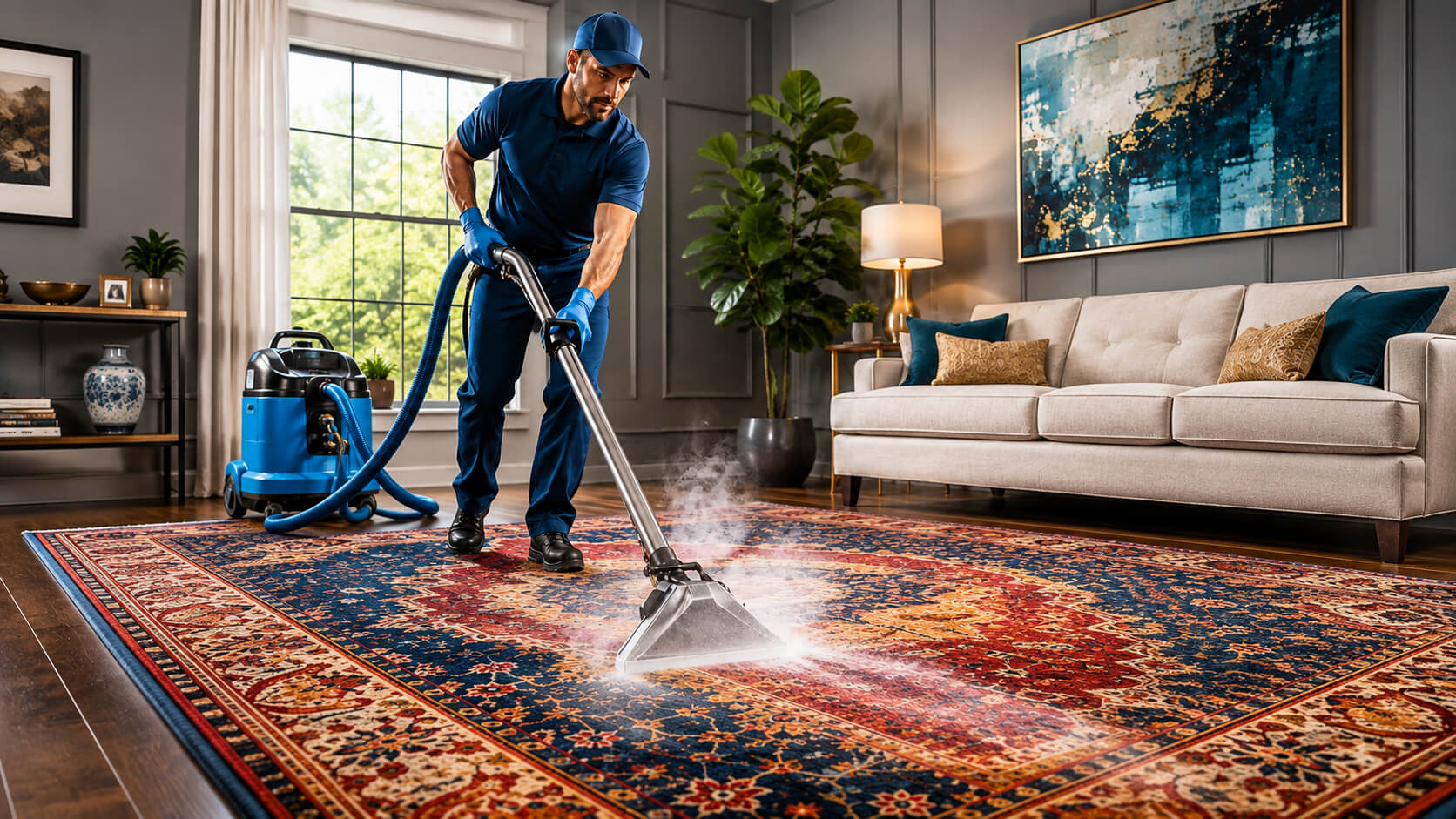
Standard carpet cleaning and specialized rug restoration are two completely different disciplines. At Americas Rug Cleaning, we see this damage every single day when ruined pieces arrive at our facility… When an on-site cleaner runs a steam wand over a natural fiber rug on your living room floor, four critical breakdown points occur.
1. The “Mud Effect”: Why Water First Is a Disaster
Standard carpet cleaning starts by spraying hot water and detergent directly into the carpet pile. On wall-to-wall nylon, that works fine. On a dense wool or cotton Oriental rug, it creates immediate structural damage.
Fine desert dust and silt are extremely fine and lodge deep inside the intricate knots and foundation of every rug. Over months and years, a rug accumulates pounds of this silt, along with dead skin, pet dander, and dust mites.
In fact, it’s common to pull 3 to 4 pounds of dry dirt out of a single 3x5 area rug.
When an on-site cleaner sprays water into an un-dusted rug, they turn 4 pounds of dry dirt into heavy mud deep in the foundation.
A surface vacuum cannot extract that mud. Once it dries, that abrasive silt turns back into hard dirt locked inside the pile, acting like tiny knives that slice away at the wool fibers every time you walk across the room.
The In-Plant Standard: Before a single drop of water touches a rug, it must undergo mechanical harmonic dusting to vibrate and slap the dry silt free from the foundation, followed by high-volume water flushing and manual squeegee work to push out remaining residue. Learn how our full-submersion off-site rug cleaning process safely flushes out years of trapped dirt.
2. Chemical Blindness & Permanent Fiber Damage
Most in-home carpet technicians are trained on synthetic materials (nylon, polyester, olefin) and use high-alkaline detergents designed to break down heavy grease on tough carpet fibers.
When those same high-pH chemicals touch natural fibers:
- Wool: Strips away natural lanolin, leaving the pile brittle, harsh to the touch, and prone to rapid re-soiling.
- Dye Migration: Unstable natural or acid dyes bleed into adjacent lighter fibers or white fringe, causing irreversible color ruin.
- Chemical Browning: Cotton foundations and cellulosic fibers turn yellow or brown as harsh chemicals dry out.
⚠️The Viscose & “Art Silk” Trap
Modern home decor features “bamboo silk,” “art silk,” or viscose area rugs. Viscose is a regenerated cellulose fiber—essentially wood pulp. Standard carpet cleaning chemicals and water wands will permanently weaken, yellow, and mat viscose fibers on contact. These pieces require strict low-moisture or solvent-based specialized handling. Which is why our dedicated Oriental rug cleaning service uses custom pH-balanced baths tailored to exact fiber types…“
3. The Mechanical Agitation Myth
Some homeowners worry that mechanical agitation damages rugs. In reality, agitation is essential—it’s what works the soap past the dense pile and down into the foundation.
The damage doesn’t come from agitation itself; it comes from the wrong kind of agitation applied on-site.
High-pressure wands dragged across hand-tied knots and delicate fringe causes, unraveling of the warp threads and pulling loose hand-knotted piles.
4. The Moisture Trap: Mold, Mildew, and Rot
Dense wool and cotton foundations act like massive sponges. A standard carpet extraction wand lacks the mechanical power to pull deep moisture out of a multi-ply woven core.
When a rug is left flat to dry on a floor with standard air movers:
- Monsoon & Humidity Slowdown: High ambient humidity drastically slows evaporation.
- Microbial Outbreak: Trapped moisture in a dark, warm pile creates ideal conditions for mold and mildew colonies within 24 to 48 hours, leaving behind a foul, musty odor that standard sprays only mask.
- Dry Rot: Prolonged dampness rots the internal cotton warp threads, causing the rug to become brittle and split when rolled.
On-Site Carpet Wand vs. In-Plant Rug Restoration
| Step |
On-Site Carpet Cleaner |
In-Plant Rug Facility |
| Dry Soil Removal |
Basic surface vacuuming |
Mechanical harmonic dusting (removes lbs of silt) |
| Fiber Identification |
Rarely tested |
Fiber & dye-stability test prior to washing |
| Chemistry |
High-alkaline synthetic detergents |
Custom pH-balanced washes tailored per rug |
| Washing Method |
Low-moisture wand spray |
High-volume flush & manual squeegee extraction |
| Drying |
24–48+ hours flat on home floor |
High-speed centrifuge + climate-controlled drying room |
Protect Your Investment
Your Oriental rug is a crafted piece of art—often an investment or family heirloom. Treating it with a quick carpet wand treatment jeopardizes its life span, texture, and value.
Take the Dust Test: Lift a corner of your rug and firmly slap the back of it over a clean floor. If a cloud of dust or a pile of fine silt hits the floor, your rug is holding pounds of trapped debris that no household vacuum or steam wand can remove.